Best Push Toys for Toddlers
Disclaimer: This post may contain affiliate links. As an Amazon Associate, we earn from qualifying purchases.
The best push toys for toddlers depend entirely on where your child is right now. A new walker may benefit from a push toy designed for supported walking play. A toddler who is already moving confidently just wants something fun to push around the room.
The five picks below cover that full range, from supportive multi-stage walkers to simple push toys that require nothing more than a toddler and some floor space.
Quick Answer: For a new walker who needs support and activities, the Skip Hop Farmstand 5-in-1 and the Fisher-Price Snack Cart Walker both grow with the child across multiple stages. For toddlers who enjoy pushing and activity play, the Fisher-Price Camper Walker combines a walker with a camping-themed activity panel, while Waddles offers a much simpler push-and-go option. For a push toy that doubles as a wagon, the VTech Activity Wagon is the pick. Keep reading to find the right fit.
Quick Picks: Best Push Toys for Toddlers
- Best for new walkers: Skip Hop Farmstand 5-in-1 Baby Walker
- Best walker with pretend play: Fisher-Price 4-in-1 Snack Cart Walker
- Best classic learning walker: Fisher-Price Laugh and Learn 3-in-1 Camper Walker
- Best simple push toy for confident walkers: Waddles the Waddle Duck Push Toy
- Best push wagon with activities: VTech Sort and Discover Activity Wagon
Comparison Table
| Toy | Type | Age Range |
|---|---|---|
| Skip Hop Farmstand 5-in-1 | Multi-stage activity walker | 6 months to 5 years |
| Fisher-Price Snack Cart Walker | Walker with pretend play | 6 months to 3 years |
| Fisher-Price Camper Walker | Walker with camping theme | 9 to 36 months |
| Waddles the Waddle Duck | Simple mechanical push toy | 12 months to 3 years |
| VTech Sort and Discover Wagon | Push wagon with activities | 12 months to 3 years |
Best Push Toys for Toddlers
Best for New Walkers: Skip Hop Farmstand 5-in-1 Baby Walker
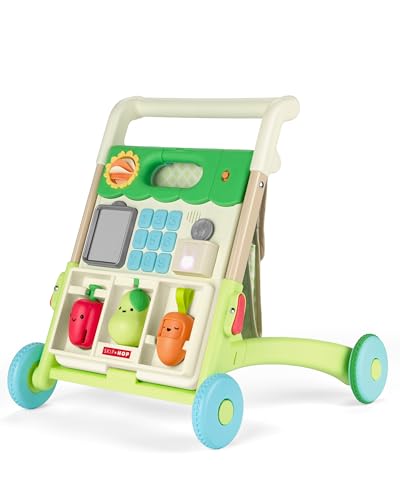
For a child who is just starting to pull up and cruise along furniture, a walker that matches their pace is the most important thing. The Skip Hop Farmstand grows through five stages: seated floor play, cruising walker, shopping cart, stroller, and standalone pretend play panel.
The non-skid rear wheels and two-speed control are designed to help manage the walker’s pace for new movers. Three handle heights adjust from 18.3 to 21.9 inches as the child grows. The detachable activity panel has 50 plus activities and can be used on the floor or as an easel when walking play is done. Buyer feedback is positive on stability, adjustability, and how long children stay interested across the different modes.
Manufacturer age guidance is 6 months to 5 years in the feature copy. Always supervise during walking use.
Best Walker with Pretend Play: Fisher-Price 4-in-1 Snack Cart Walker

This one bridges the gap between first walker and pretend play. It starts as a seated activity center, becomes a push walker, then turns into a shopping cart and food-service station as the child grows into it.
Fourteen food and shape-sorting pieces come with it, and the built-in learning content works in English, Spanish, French, and Brazilian Portuguese across three Smart Stages levels. Buyer feedback is positive on playability, walking support, and the age range it covers. Manufacturer age guidance is 6 months to 3 years.
Best Classic Learning Walker: Fisher-Price Laugh and Learn 3-in-1 On-the-Go Camper Walker

The Fisher-Price Camper Walker has a camping theme that sets it apart from the food and farm options elsewhere on this list. It starts as a seated activity center, becomes a push walker, then converts to a standalone pretend-play camper station.
The activity panel includes ABC and music buttons, a compass, a map, a stove, and a lantern, plus 15 camping play pieces including a fishing shape sorter, a rattle coffee pot, and a clicker dial. Three Smart Stages levels adjust the learning content as the child grows. Buyer feedback praises the fun theme, quality, music, and stability. Manufacturer age guidance is 9 to 36 months.
Best Simple Push Toy for Confident Walkers: Waddles the Waddle Duck

Once a toddler is walking confidently, a simple push toy can be more interesting than a walker built mainly for support. Waddles fills that role well.
The duck waddles and quacks mechanically as the child pushes it forward. No batteries, no setup. The handle snaps together and it is ready to go. Buyer feedback is generally positive about the simple push-and-quack play. Manufacturer age guidance is 12 months to 3 years. Some reviewers note the quack mechanism can stop working after extended use.
Best Push Wagon with Activities: VTech Sort and Discover Activity Wagon
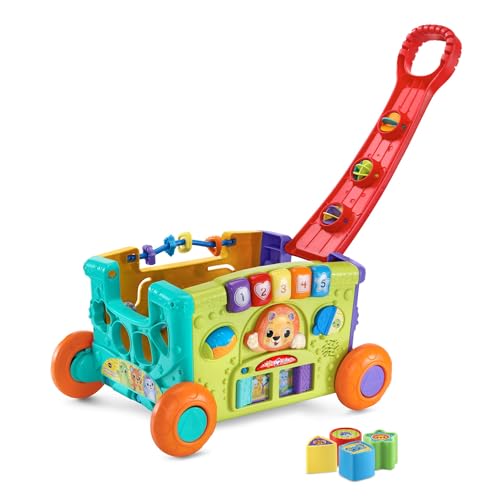
For a toddler who wants to push something around and load it up at the same time, the VTech Activity Wagon covers both. Five sides of built-in activities include shape sorting, gear spinners, peek-a-boo doors, a key panel, and a bead maze. Movement triggers music and sound effects.
The folding handle doubles as a fifth play surface when the wagon is parked. Toddlers can push it around, fill it with toys, and sit down to play with the activity panels between laps. Buyer feedback is positive on the sturdy build, easy assembly, and activity variety. It comes in red or pink. Manufacturer age guidance is 12 months to 3 years.
How to Choose the Right Push Toy for Your Toddler
The first question is whether your child still needs walking support. For toddlers who are just starting to pull up and take first steps, features like speed control and a broad base can be useful. The Farmstand and the Snack Cart both have two-speed wheel control designed to help manage how quickly the toy rolls.
Once a toddler is walking confidently, a simple push toy like Waddles or the VTech Activity Wagon gives them the joy of pushing something around without the walking-aid structure they may have outgrown.
Multi-stage designs that include detachable activity panels or pretend-play modes can remain useful well after the walking phase ends. The Skip Hop Farmstand lists an age range through 5 years specifically because the play panel stays relevant long after the walker itself is set aside.
Always supervise toddlers during walker use, particularly near stairs or uneven surfaces.
Frequently Asked Questions
What age do toddlers use push toys?
Age ranges vary by product. The walkers in this article start at either 6 or 9 months for seated activity play. Simple push toys like Waddles and the VTech Wagon start at 12 months. Check the manufacturer age guidance on each listing before buying.
What is a push walker used for?
A push walker gives toddlers a handle and rolling toy to move behind during supported walking play. Models with speed-control wheels are designed to manage how quickly the toy rolls. Development varies from child to child, so follow the manufacturer age guidance and supervise use throughout.
What is the difference between a push toy and a pull toy?
A push toy goes in front of the child and they walk behind it. A pull toy has a string and trails behind as the child walks forward. For wooden pull-along toys specifically designed for confident walkers, see our Best Pull Toys for Toddlers guide.
Do push walkers work on carpet?
Most push walkers in this article are designed for indoor use on both hard floors and low-pile carpet. The Skip Hop Farmstand and Fisher-Price Snack Cart both have non-skid or rubberized wheel elements. Check the individual listing for surface guidance before buying.
Are push toys good for indoor use?
All five picks in this article are designed for indoor use. The Waddles Duck is mechanical and needs no batteries. The VTech Wagon has electronic sounds and requires batteries for that feature. Check the current listing for battery requirements before buying.
More Toddler Toy Guides
- Best Pull Toys for Toddlers — wooden pull-alongs organized by what the toy does when pulled, from wriggling crocs to bouncing frogs.
- Best Walking Toys for Toddlers — activity walkers, wagon walkers, and wooden push and pull toys matched to every walking stage.
- Best Ride-On Toys for Toddlers — balance bikes, push cars, tricycles, and scooters matched to different stages of toddler development.
- Best Toys for Active Toddlers — indoor and outdoor options for high-energy kids who never stop moving.