Best STEM Toys for Kids Ages 8 to 12 by Learning Style
Disclaimer: This post may contain affiliate links. As an Amazon Associate, we earn from qualifying purchases.
“STEM toy” can mean almost anything. It might be a marble puzzle that takes five minutes to understand, a robot with dozens of tiny parts, or a chemistry kit that takes over part of the kitchen counter.
That makes choosing the best STEM toys for kids ages 8 to 12 less about finding the most educational-looking box and more about finding the right kind of challenge. Some children want to solve problems quietly. Others want to build machines, control robots, examine tiny objects, or make something bubble over.
The toys below are grouped by the kind of child most likely to enjoy them, so you can skip the options that look impressive but don’t match how your child actually plays.
| Toy | Best For | STEM Focus | Adult Help | Screen-Free? |
|---|---|---|---|---|
| Snap Circuits Jr. SC-100 | Electronics-curious kids | Circuits | Low to medium | Yes |
| ThinkFun Gravity Maze | Puzzle solvers | Logic and gravity | Low | Yes |
| Smartivity Mechanical Hand | Hands-on builders | Mechanical engineering | Medium | Yes |
| Smartivity Pinball Machine | Build-and-play kids | Physics | Medium | Yes |
| Thames & Kosmos Mechanical Engineering | Older kids wanting a challenge | Machines and motion | Medium to high | Yes |
| National Geographic Chemistry Set | Curious science kids | Chemistry | Medium | Yes |
| National Geographic Microscope | Nature and biology kids | Observation | Low to medium | Yes |
| Sillbird Robot Building Kit | Robot and tech fans | Robotics | Medium | Partly |
| Bottleboom Solar Robot Kit | Solar robotics intro | Solar power | Medium | Yes |
Quick Answer
ThinkFun Gravity Maze is the best fit for puzzle lovers, while Snap Circuits Jr. offers the quickest payoff for children interested in electronics. Smartivity suits hands-on builders, and the National Geographic chemistry set is the strongest choice for active experiments. For an older child ready for a longer project, the Thames & Kosmos engineering kit offers more depth.
For the Puzzle Solver
A marble that misses the target is not a failure to this kind of child. It is a reason to rearrange the towers and try again.
ThinkFun Gravity Maze

ThinkFun Gravity Maze is part marble run, part logic game. Kids use challenge cards to figure out which tower pieces to place where, then drop the marble and see if it reaches the target. There are no batteries, no screens, and the challenge cards scale from beginner to advanced, giving it staying power well beyond the first few sessions.
Children who already enjoy Rush Hour, maze puzzles, or brain teasers will understand the appeal quickly. It suits quiet concentration more than active building or messy experiments.
Skip it if your child gets frustrated with trial and error. This works better as a family activity at first than as solo play for a child who gives up after one failed attempt.
For the Kid Who’s Curious About Electronics
Not every STEM-minded kid wants a puzzle. Some want to know how the lights, fans, and switches around the house actually work.
Snap Circuits Jr. SC-100 Electronics Exploration Kit

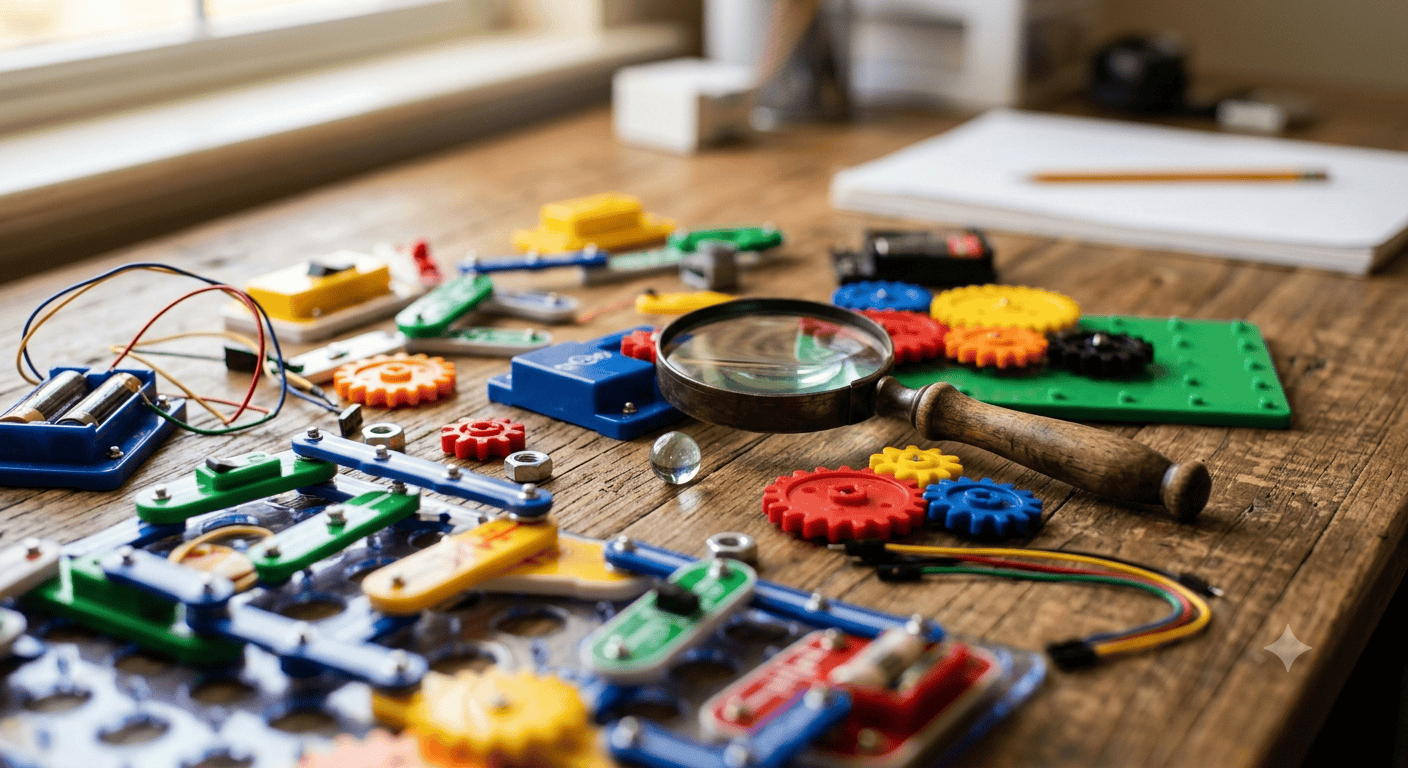
Snap Circuits Jr. skips the wires and soldering entirely. Kids snap pieces onto a board and follow the project manual to build something that lights up, moves, or makes a sound. With over 100 projects in the manual, a curious kid who finishes one quickly will have plenty more to move through.
Snap Circuits is especially satisfying for children who want something to happen soon after they begin building, rather than spending a long time assembling before seeing results.
Skip it if your child wants total creative freedom. This is a project-based kit with guided builds, not a freeform system, so a child who resists following steps will find it limiting.
For the Hands-On Builder
Some kids learn best by assembling something themselves and then watching it actually move. These two kits are built around that instinct.
Smartivity DIY Robotic Mechanical Hand

This isn’t a robot in the app-controlled sense. It’s a mechanical hand that kids assemble piece by piece, and once it’s built, the fingers actually move. Children who like taking things apart or asking how machines work tend to get the most out of this one. The finished build has enough of a wow factor to feel rewarding beyond a typical one-and-done craft.
Skip it if your child wants to play immediately after opening. Children at the younger end of the age range may need help with some assembly steps, and the payoff comes from the building process, not a ready-made toy. If your child gets impatient with longer builds, the Snap Circuits kit is the faster alternative.
Smartivity DIY Pinball Machine

This one has an edge over a typical building kit: once it’s assembled, kids get an actual working pinball-style game out of it. That gives the build a purpose beyond just following steps, and the STEM value comes through in how the finished toy uses angles, force, and timing.
It lands well with kids who already like arcade games, ramps, or cause-and-effect mechanisms, and who don’t mind some assembly time before the payoff.
Skip it if your child has low patience for multi-step builds. Children at the younger end of the age range may need more assembly help, while a patient 10 to 12-year-old is more likely to complete it independently.
For the Future Engineer
For a builder who’s ready for something more involved, this kit offers depth that the single-project options can’t match.
Thames & Kosmos Mechanical Engineering: Machines & Vehicles

Rather than building one thing and stopping, kids can explore force and motion through models such as cranes, vehicles, and windmills. That breadth makes it a better fit for the older end of this age range, or for a child who’s already shown they can stick with a longer project.
Skip it if your child wants fast action. A quicker kit like Snap Circuits will hold their attention better if patience is limited.
For the Kid Who Loves Experiments
Measuring, mixing, and waiting for a visible reaction is the fun here, not just reading the explanation afterward.
National Geographic Amazing Chemistry Set

This kit covers the classics: reactions, crystal growing, color changes, and glowing experiments. It’s built for a kid who wants to ask “what happens if?” and then actually try it, rather than read about a reaction happening to someone else.
It’s a better match for active experimenters than for kids who prefer quiet, independent puzzles.
Skip it if you’re looking for an hour of fully independent play. This kit is better with an adult nearby for measuring, setup, and cleanup, especially for children at the younger end of the age range.
For the Quiet Observer
Microscopes reward the child who notices the speck on a leaf, the texture of a rock, or the tiny details everyone else walks past.
National Geographic Dual LED Kids Microscope

This microscope comes with prepared slides to start and blank slides for kids to make their own. The blank slides open up a lot of independent exploration once a child gets comfortable with the prepared ones. It suits a child who likes nature, bugs, rocks, or collecting small things from outside, and who enjoys a slower, more observational kind of play.
It also works well for a kid who gets overwhelmed by multi-step builds. There’s still real learning here, just at a calmer pace.
Skip it if your child wants fast action or a hands-on build. This rewards patience and attention to detail, not speed or construction.
For the Robot and Tech Fan
These two kits both scratch the robot-and-movement itch, at different complexity levels.
Sillbird Robot Building Kit with Remote Control
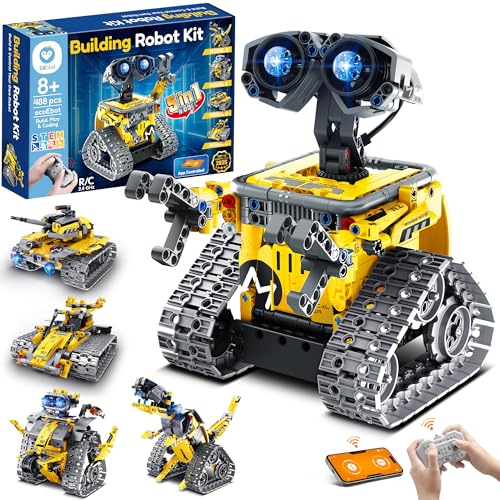
Kids build different robot-style models, then control them with a remote or app. That makes it a step up from a basic building set, and a decent bridge into beginner robotics. Kids can dismantle the model and rebuild it in several different forms, which gives them more reasons to return to it than a single fixed build would.
It tends to suit the older or more patient end of this age range best. A first-time 8-year-old builder may need more help than a 10 to 12-year-old would.
Skip it if you want something fully screen-free. The remote works without a device, but some additional controls require the app.
Bottleboom 13-in-1 Solar Power Robot Kit

Kids can assemble 13 different models powered by the included solar panel. The panel performs best in direct sunlight, so indoor results may be limited.
It’s a solid fit for a kid who likes construction sets and vehicles and doesn’t mind small parts during assembly.
Skip it if your child expects a toy to work right out of the box. The small parts and careful assembly can be a sticking point for a child who gets frustrated before the build is finished.
How to Choose the Best STEM Toy for Your Child
Once you’ve narrowed things down, the deciding factor usually isn’t age. It’s interest, patience level, and how much screen time you’re comfortable with.
Start With What They Already Love
A child who’s into animals and nature will usually get more out of a microscope than a robot kit, even if the robot looks more exciting on the box. Match the toy to the interest your child already has, rather than the one you wish they had.
Be Honest About Frustration Tolerance
A logic game like Gravity Maze starts simple and gets harder. A chemistry kit needs setup and cleanup. A robot kit can be exciting but fiddly to assemble. None of that is a problem on its own, but it’s worth picking the kind of challenge your child can actually stick with.
Decide How Hands-On You Want to Be
Some options are easier to hand over after a brief introduction, while chemistry sets and larger builds usually need more adult involvement. Neither approach is better, but it’s worth knowing which one you’re signing up for.
Look for Replay Value
A toy with multiple challenge cards, rebuildable models, or repeatable experiments has a better chance of being used more than once. The Gravity Maze, Snap Circuits Jr., Thames & Kosmos kit, and the multi-model robot kits all give children something new to attempt after the first session.
Figure Out Where You Stand on Screens
The Gravity Maze, Snap Circuits Jr., microscope, chemistry set, and mechanical building kits can all be used without an app or tablet. Robotics kits sometimes lean on an app for extra features, which can be worth it, but it’s better to know that going in than to find out after opening the box.
FAQ About STEM Toys for Kids Ages 8 to 12
What are the best STEM toys for kids ages 8 to 12?
Strong options include ThinkFun Gravity Maze for logic puzzles, Snap Circuits Jr. for electronics, Smartivity kits for hands-on building, the National Geographic chemistry set for experiments, and the Thames & Kosmos kit for more involved engineering projects. The best choice depends on the child’s interests and patience level.
Are STEM toys worth it?
STEM toys can be worth it when they offer real hands-on learning and replay value. The best ones help kids build, test, observe, solve problems, or understand how something works. A toy is less useful if it only has “STEM” on the box but doesn’t encourage real thinking or experimenting.
What STEM toy is best for a child who gets frustrated easily?
Start with a toy that has quick wins and simple setup. Snap Circuits Jr. works well because the pieces snap together and the projects are guided. A microscope can also be a calmer option if the child likes nature and discovery.
What STEM toy is best for kids who love building?
The Smartivity DIY Robotic Mechanical Hand, Smartivity DIY Pinball Machine, and Thames & Kosmos Mechanical Engineering are all good fits for hands-on builders at different levels of complexity and patience.
Do STEM toys need screens?
No. The Gravity Maze, Snap Circuits Jr., microscope, chemistry set, and mechanical building kits can all be used without an app or tablet. Some robotics kits use an app for extra features, but the core play is usually possible without one.
What is the difference between STEM and STEAM toys?
STEM stands for science, technology, engineering, and math. STEAM adds art. A STEAM toy may include design, creativity, drawing, color, music, or artistic building alongside science, technology, engineering, or math.
One Last Thing
You don’t need to choose the toy that promises the most projects or uses the most impressive technology. Start with the activity your child already returns to: solving, building, experimenting, observing, or controlling something that moves.
Once that part is right, the STEM learning usually follows naturally. A child who wants to see whether the marble reaches the target or why the circuit won’t light up is already doing the useful part: testing an idea, noticing what went wrong, and trying again.
“`