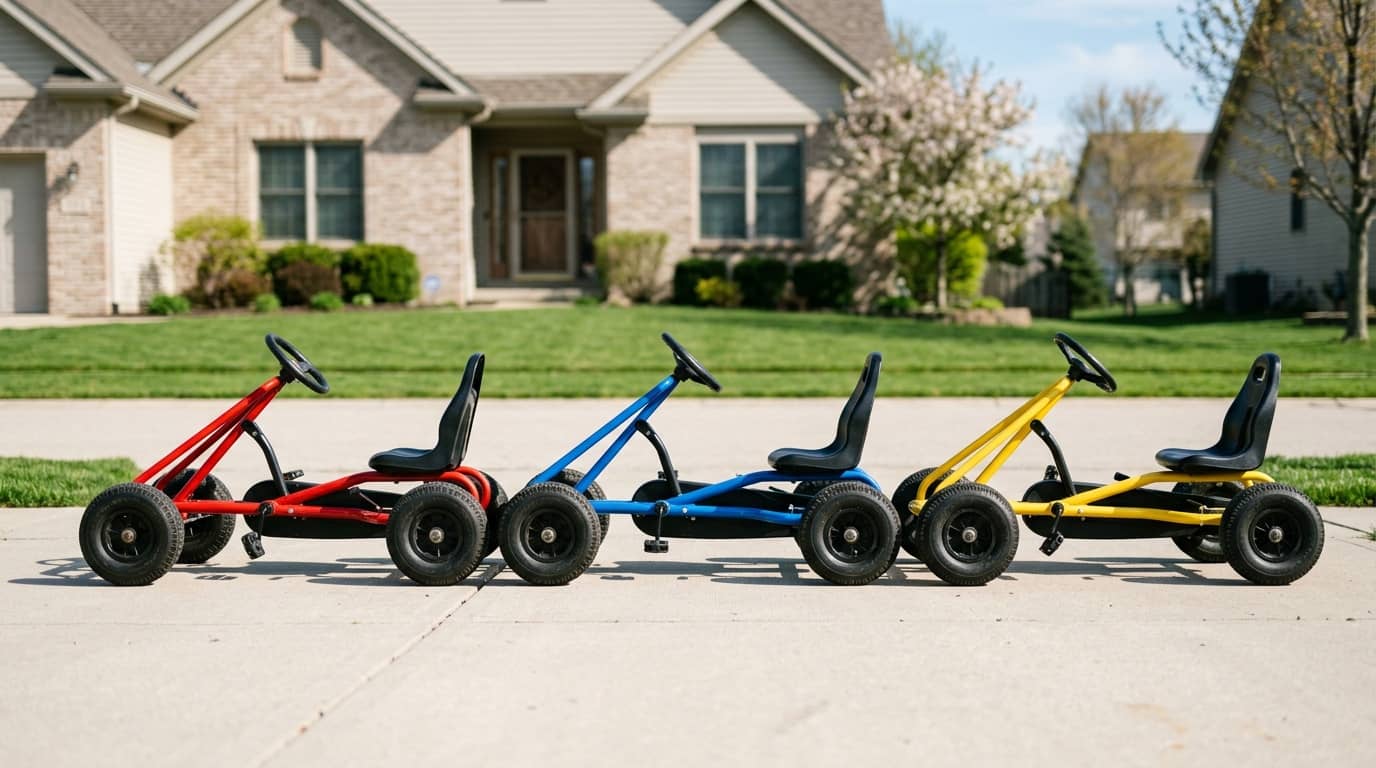
Best Pedal Go Kart for Kids: BERG vs Razor vs Costzon
Disclaimer: This post may contain affiliate links. As an Amazon Associate, we earn from qualifying purchases.
The best pedal go kart for kids depends on the child’s age, coordination, available riding surface, and whether they want a traditional pedal kart or something built for drifting.
Quick Answer
For a child who specifically wants drifting and spinning, the Razor Crazy Cart Shuffle is the standout pick.
For a younger child who needs stability first, the BERG Buzzy Jeep Sahara is the most stability-focused option in this guide.
For a traditional pedal kart with conventional steering and braking, the Costzon Go Kart covers the basic format.
Razor Crazy Cart Shuffle

The pick for kids who want something that does not behave like a normal kart.
This is not a traditional pedal kart. Kids shuffle their feet back and forth on a foot bar to build speed, then lift the Drift Bar handle to send the rear caster wheels into a spin or slide. No chain, no standard pedals, no batteries.
Reviewers often mention that children learn the shuffle-and-drift motion quickly, although the exact learning curve depends on balance and coordination.
Rated for ages 4 and up. The frame has five length settings, which allows adjustment for riders of different heights within the manufacturer’s age and size limits.
The Crazy Cart Shuffle has no conventional brake. Razor instructs riders to lower the Drift Bars and place both feet on the ground to slow and stop. It may not suit a cautious or inexperienced rider. Use it only in a clear, level riding area with adult supervision and appropriate protective gear.
BERG Buzzy Jeep Sahara

The pick for a younger child who needs stability before speed.
Built for roughly ages 2 to 5, the four-wheel swing axle is designed to help all four wheels maintain contact on uneven surfaces. For a toddler or young preschooler still building balance and coordination, that matters more than any other feature on the box.
It uses a direct-drive pedal system rather than a chain. Some reviewers describe this as easier for younger children to start pedaling than a chain-driven setup.
The seat adjusts as your child grows. The steel frame, direct-drive system, adjustable seat, and available replacement parts make serviceability one of its clearest practical advantages.
BERG highlights replaceable spare parts and independent testing to European safety standards. Those features matter most to families who want a kart that can be serviced rather than discarded if a component wears out.
If your child is already on the older end of this kart’s range, we covered BERG’s larger Buddy model in our full BERG Buddy pedal go kart review.
Costzon Go Kart

The conventional pedal go kart in this lineup.
Four wheels, a steering wheel, a hand brake, and a gear lever that locks the pedals for coasting downhill. Rated for ages 3 to 8 with a two-position adjustable seat.
Reviews are more mixed than for the other two picks. Common complaints mention sizing, wheel alignment, and inconsistent build quality between units.
It suits families looking for a conventional pedal kart with an adjustable seat, hand brake, and coasting function. Read the sizing and assembly feedback carefully, especially for a child near the upper end of the stated age range.
What About Drift Trikes for Older Kids?
If you have come across the Razor DXT Drift Trike while researching pedal karts, it is a meaningfully different product built for a much older rider.
The manufacturer recommends ages 14 and up, with a 198-pound weight capacity. It belongs in a teen or adult drift-trike comparison rather than a young-child pedal-kart guide.
How to Choose the Right Pedal Go Kart
Match the kart to the age, not just the listing. Retail listings may show broad or inconsistent age ranges. Prioritize the manufacturer’s stated age range, maximum rider weight, seat adjustment, and assembled dimensions.
Decide how much stability you need. A younger or less coordinated rider benefits from a kart built around stability, like the BERG Buzzy’s swing axle design. An older child who already rides a bike confidently may prefer a drift-focused design such as the Crazy Cart Shuffle.
Factor in surface type. Pedal karts generally require more effort on grass, dirt, and gravel than on smooth pavement. Check the tire design and manufacturer guidance for the exact model.
Check serviceability and replacement parts. Some manufacturers sell replacement tires, pedals, seats, and hardware, while others do not. That can matter if the kart will be kept for several seasons or shared between children.
Frequently Asked Questions
How do children stop a pedal go kart?
It depends on the model. The Crazy Cart Shuffle has no conventional brake. Razor instructs riders to lower the Drift Bars and place both feet on the ground to slow and stop. The Costzon includes a hand brake. The BERG Buzzy uses a foot brake on the pedal. Always follow the manufacturer’s stopping instructions, use a clear level riding area, and ensure adult supervision and appropriate protective gear.
Do pedal go karts work on grass?
Many pedal karts are easiest to pedal on smooth, level surfaces. Grass and loose ground increase rolling resistance, and performance varies by tire type and gearing.
What should I look for in build quality?
Look for an adjustable seat, secure steering components, clear braking instructions, available replacement parts, and a frame rated for the child’s size. Assembly feedback and parts availability are often more useful than brand reputation alone.
What age is the Razor DXT Drift Trike for?
The Razor DXT Drift Trike is built for ages 14 and up. It is a completely different product category from the pedal karts in this guide and is not suited for young children.
Which Pedal Go Kart Fits Which Child?
Choose the BERG Buzzy when stability and a younger rider are the priority.
Choose the Crazy Cart Shuffle when the child specifically wants drifting and understands and can follow its foot-down stopping method.
Choose the Costzon when you want a conventional pedal-kart layout with an adjustable seat and hand brake, while accounting for the more mixed assembly and sizing feedback.
The right kart is the one that fits the child’s size, coordination, riding surface, and preferred style of play.