Pedal Powered Go Kart Review: The BERG Buddy
Disclaimer: This post may contain affiliate links. As an Amazon Associate, we earn from qualifying purchases.
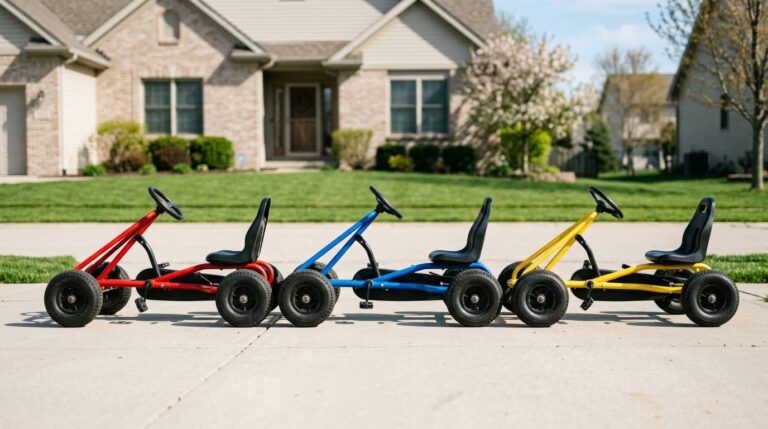
If you are looking for a pedal powered go kart with an adjustable seat, pneumatic tires, BFR pedaling, and available replacement parts, the BERG Buddy is one of the more serviceable options in this category.
How the BERG Buddy Pedal Powered Go Kart Works
The Buddy uses what BERG calls the BFR system: Brake, Freewheel, and Reverse, built directly into the pedals.
Push forward to go. Stop pedaling to coast. Pedal backward to brake and reverse. No hand lever required.
Combined with a swing axle designed to help all four wheels maintain contact on uneven surfaces, it uses a steel frame, pneumatic tires, and an integrated pedaling and braking system rather than a simple plastic ride-on design.
BERG Buddy Blue

The Blue model is the standard color option and uses the same BFR system, adjustable seat, swing axle, and pneumatic tires as the other Buddy variants.
BERG lists the Buddy for riders within its stated height range of 100 to 130 cm. Check the current manufacturer guidance because retailer age labels may differ.
The pneumatic tires are designed to provide more cushioning over uneven surfaces than solid plastic wheels. Its neutral blue design may suit families who prefer a less themed appearance.
Some reviewers mention checking chain tension and avoiding tire overinflation. These are useful maintenance points to understand before the first ride.
BERG Buddy Lua
 The main difference is the color scheme. Both listings use the same BFR system, adjustable seat, swing axle, and pneumatic-tire format. The Lua swaps in a softer pink-and-teal color scheme.
What Reviewers Commonly Mention
Reviewers often mention the adjustable seat, pneumatic tires, steering, and BFR pedal system as highlights. Common criticisms include the hard plastic seat, maintenance of the chain and tires, and the coordination required to brake and reverse through the pedals.
BERG Buddy Construction and Serviceability
The Buddy uses a steel frame and replaceable components, which makes maintenance and repair more practical than on karts without replacement-part support.
BERG sells replacement parts for many Buddy components, including selected tires, chains, pedals, seats, and hardware. A worn component may be replaceable without replacing the entire kart.
BERG states that its products are tested against applicable European safety requirements. Check the current Buddy product documentation for the exact certifications and markings that apply to the model sold in your region.
BERG also publishes sustainability information for selected products and materials, but certification can vary by model.
The chain, tires, and moving parts still require routine inspection and maintenance.
Who the BERG Buddy May Not Suit
The Buddy may not suit a child outside the manufacturer’s height range, a family that has only soft or uneven riding surfaces, or anyone wanting a lightweight kart that can be carried easily. It also requires assembly and routine checks of the tires, chain, steering, and seat position.
Frequently Asked Questions
What age is the BERG Buddy pedal powered go kart for?
BERG lists the Buddy for riders within its stated height range of 100 to 130 cm. Check the current manufacturer guidance because retailer age labels may differ from BERG’s own specifications.
What is the difference between the Buddy Blue and Buddy Lua?
The main difference is the color scheme. The Buddy Blue and Buddy Lua both use the same BFR system, adjustable seat, swing axle, and pneumatic-tire format.
Does the BERG Buddy require assembly?
Yes. Assembly is required. Review the instructions before beginning and allow extra time for seat, steering, chain, and tire checks.
What makes the BERG Buddy different from simpler pedal karts?
The Buddy combines a steel frame, pneumatic tires, an adjustable seat, BFR pedaling, a swing axle, and access to replacement parts. Those features may matter most to families prioritizing adjustability, maintenance access, and serviceability.
Does a pedal powered go kart work on grass?
Grass and uneven terrain create more rolling resistance than smooth pavement. Performance will depend on the rider’s strength, tire pressure, slope, and ground conditions. Smooth, level pavement generally provides the easiest pedaling surface for the BERG Buddy.